Private beta · 20 places
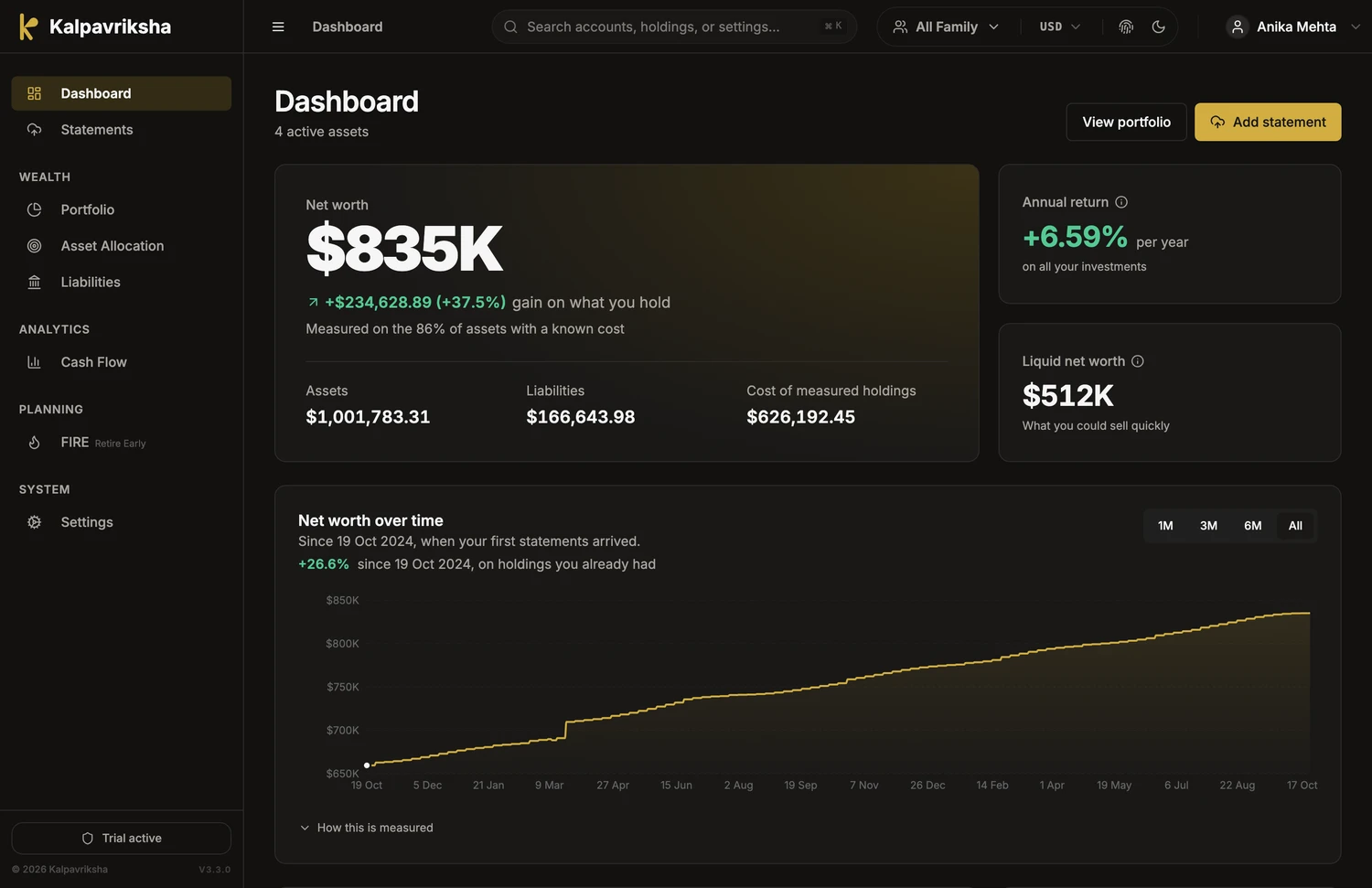
For wealth spread across borders, currencies and legal structures, the simplest question has no clean answer: what am I worth, and is it working. Kalpavriksha builds the whole picture from the statements you already receive, and keeps it encrypted on your own machine. No bank logins, and no portfolio in anyone's cloud.
Illustrative figures. The conversions are real arithmetic at the rates shown in the page source.
No logins. No CSV wrangling. No evening with a spreadsheet and a browser tab open on every bank you use.
Try importing a statement
Click here to simulate dragging in a broker PDF
✓ Encrypted & Saved Locally
Nine kinds of thing, in ten currencies, in one total. Debt is netted off rather than left out, because a net worth that ignores your mortgage is not a net worth.
And what it hands back
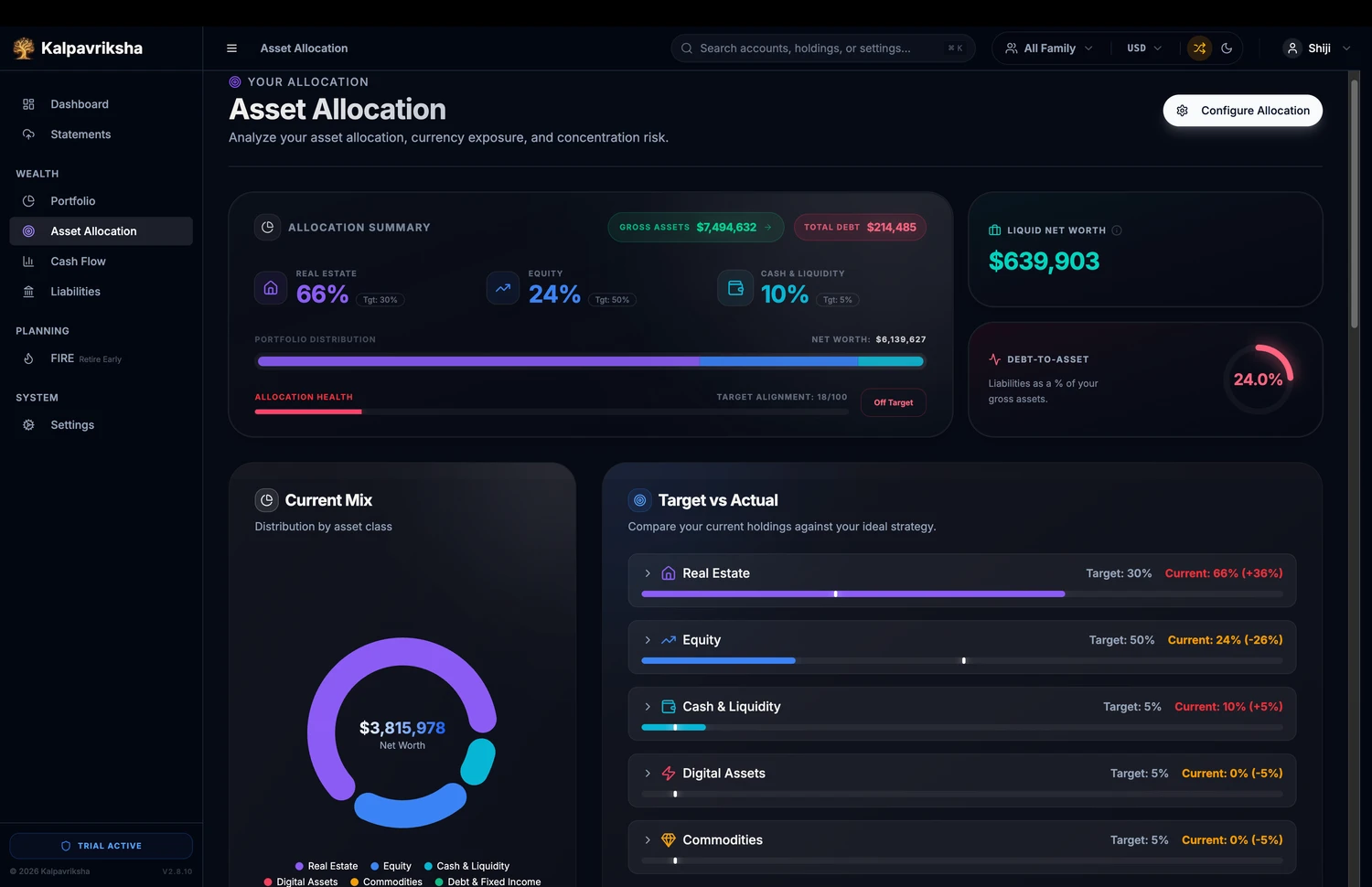
Allocation against your target
Equities are 8 points over. Trim about $79,000, and here are the holdings to trim.
Bar is where you are. Notch is where you said you wanted to be.
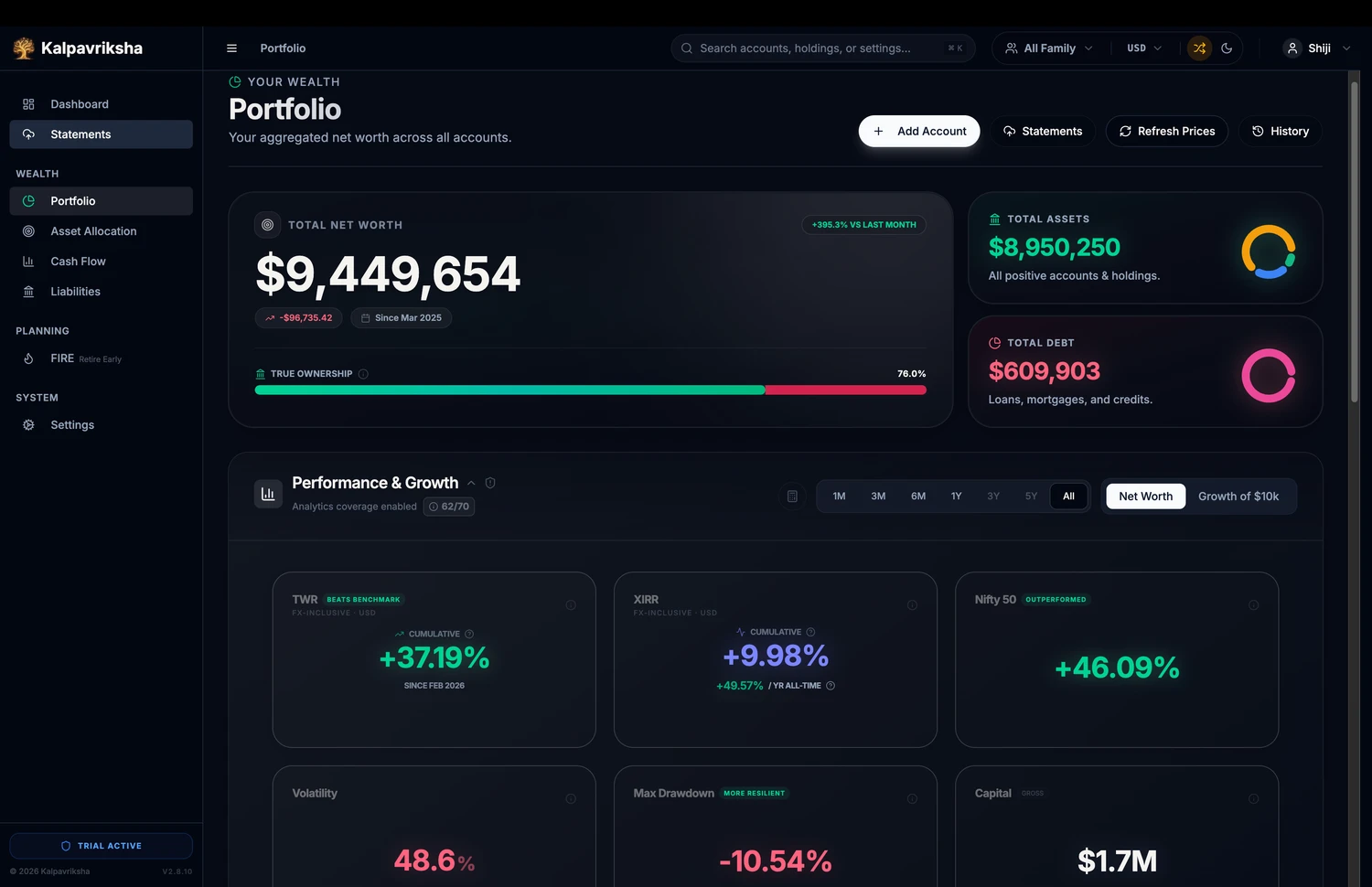
What it actually returned
+6.77% money-weighted, measured over the same holdings the charts draw, so the number and the picture cannot disagree.
How close you are to stopping
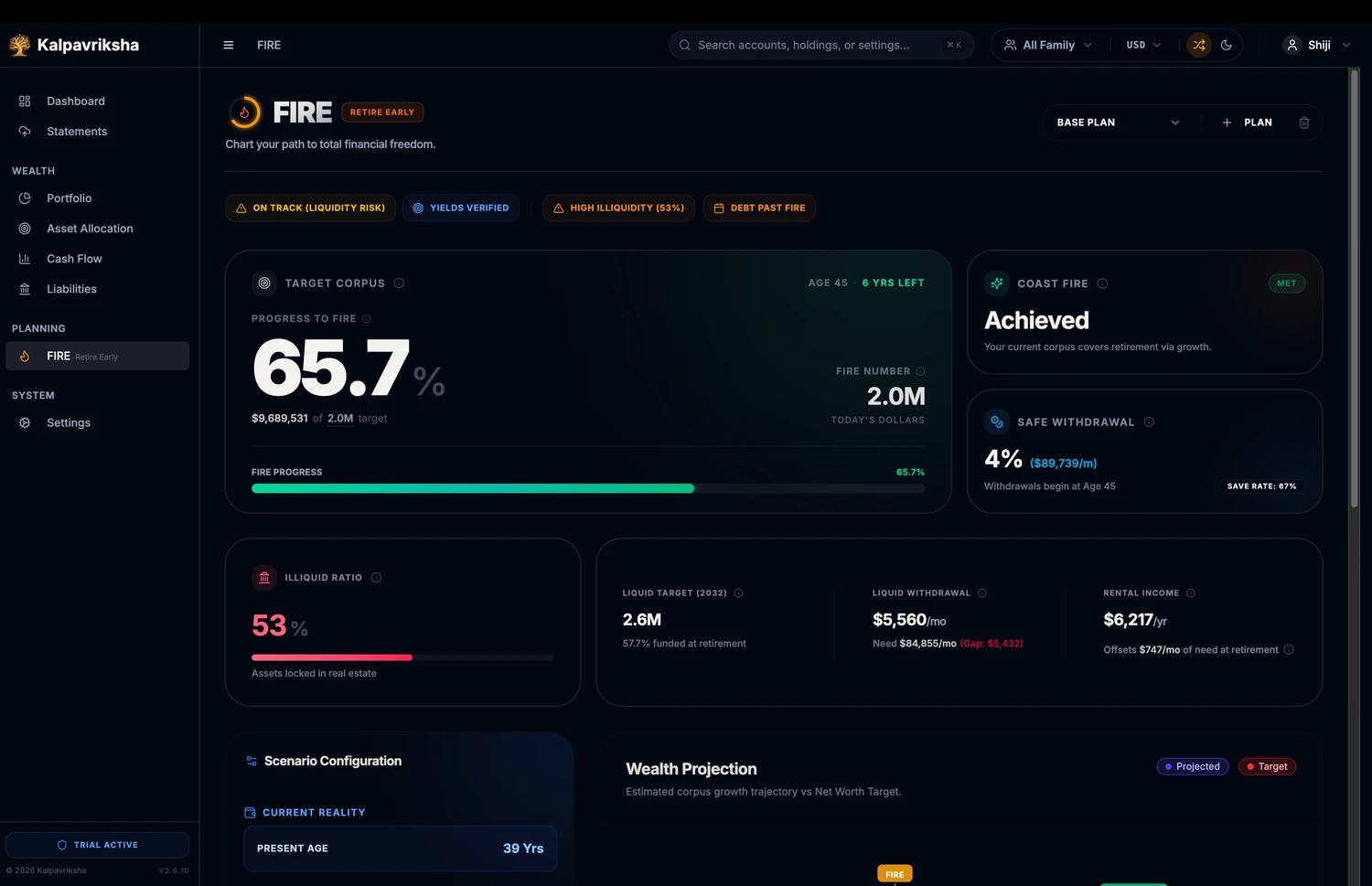
On plan for 2041, four years before the date you set, at your current rate of saving.
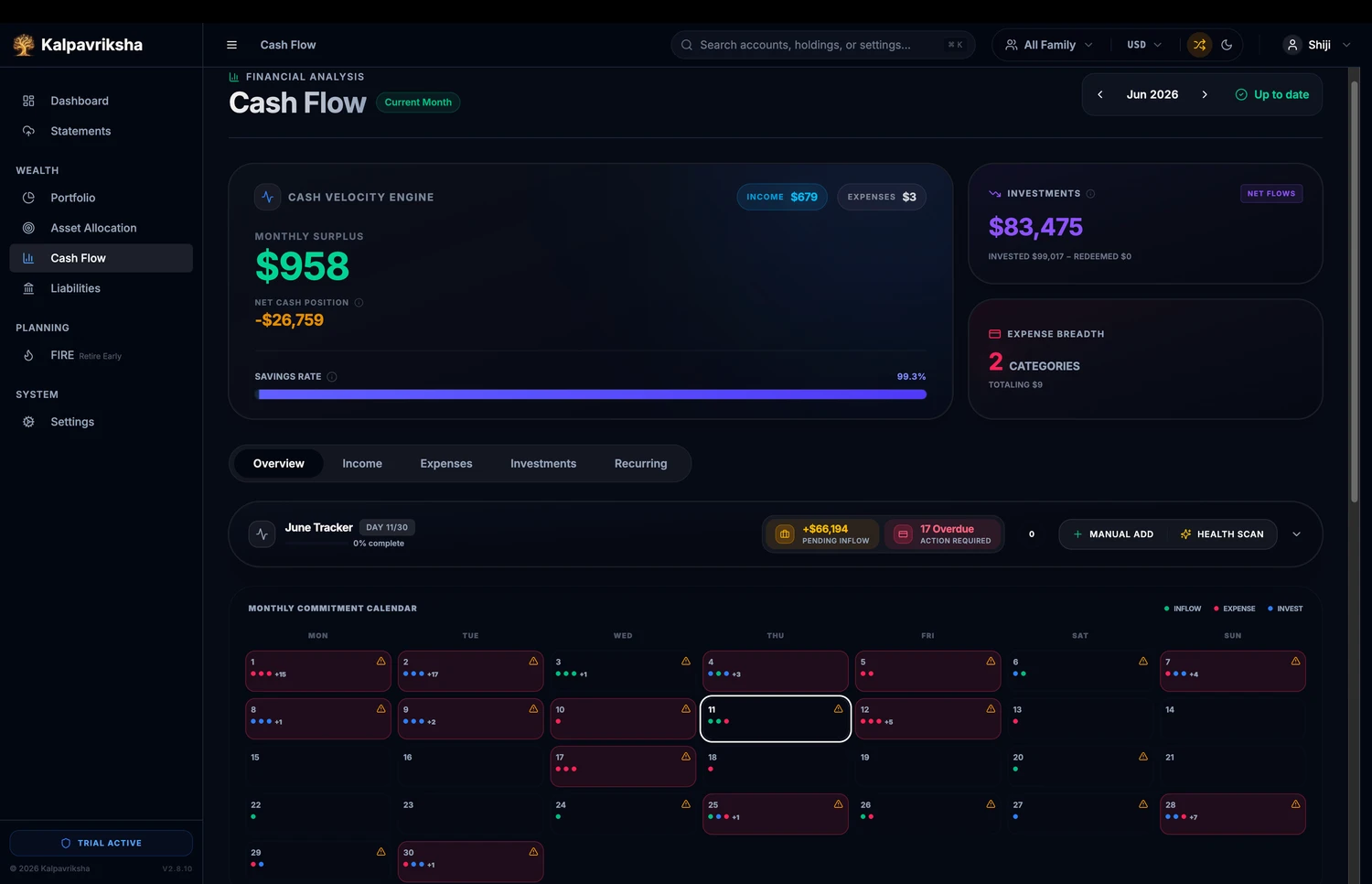
Performance, allocation, cash flow and your path to retiring early. Four views over one set of numbers, so they cannot disagree.
Portfolio performance and returns
Not a policy promise. There is no database on our side that could hold one.
We never ask for a credential to an account of yours, because we never connect to one. You give it statements, the same PDFs your broker already emails you.
You do not have to find a setting first. Names, account numbers, card numbers, IBANs and any term you add are stripped on your machine before anything is sent. You see the masked text and approve it before anything moves. If the text cannot be read for review, processing stops rather than sending it anyway.
The reading is done by an AI model, and it is yours: your Gemini account, your API key, stored encrypted on your machine. Your statements never touch a server of ours. Your arrangement with Google is yours, and we do not speak for it either way.
Licensing, and the beta signup. Between them they hold your email address, your licence key, a device id, the three answers you gave on the signup form, and whether we have approved your beta request. That is the whole list, and we would rather you read it here than discover it later.
Want a second opinion on your portfolio? Copy an anonymised summary of your holdings and paste it into any AI or send it to an advisor. The code that builds that summary is not given your accounts, institutions or addresses in the first place, so it cannot leak them.
Aggregators need your bank logins because reading a statement used to be impossible without a team writing a parser per institution, per format, forever. That cost is why every one of them ended up holding your credentials and your balances on their servers. It was the only way the maths worked.
That constraint is gone. A good model reads a statement it has never seen, and it can analyse a holdings list without ever being told whose it is. So the app does not need to be the intelligence. It needs to be the plumbing that keeps your identity out of the way, and that is a much smaller thing to trust.
For most people with money in several places, the choice has been a spreadsheet that goes stale or a person who charges a percentage of everything you own.
Of everything you own, in a good year and a bad one, and it grows as you do. A good fee-only advisor removes the incentive problem and is worth every penny. They are also rare, and you still hand your whole picture to someone.
Free, until you miss two months and stop trusting it. Which is what happens, and why most people cannot answer the question at all.
Flat, and it does not grow when your portfolio does. Nobody else holds your picture, and you still own the decisions. You can only manage what you measure, and this is the measuring.
Including the ones with answers we would rather you heard from us.
We onboard a small group at a time and write every invite by hand, so tell us a little about how your money is arranged and we will come back to you.
Three questions, all clicks, under a minute. Every one is optional.
We hold your email address and the three answers above. That is everything. No name, no phone number, no company, and no figures: you have told us the shape of your money, never what is in it. We never sell or share your email address, and we never ask for a postal one.
Six emails, and here they are: a confirmation now, an invite when a spot opens, two asking how it is going, and two before your trial ends. Asking how it is going is rather the point of a beta. Every one of them carries an unsubscribe link that works.